
Knowing your business model gives direction

When you fly for a living - it's the best job in the world....until you get laid off, or displaced and have to juggle flying with the "real" world of paying bills.
In creating an additional source of income, it can be daunting to decide what to do, what to create, which opportunities to pursue.
Most businesses, and investments for that matter, can be tucked neatly into one of four business models.
Knowing which category your idea fits will provide guidance, to pinpoint your direction as to how to capture opportunity, minimize risks and avoid threats.
This is the part they don't teach you in basic flight school (which fits nicely in a B2C business model).
The four business models are:
1. B2C - business to consumer. This is the most common businesses module, where a business sells to a consumer. Basically anything you buy either in a store, or on line, say household supplies, light bulbs, clothing, entertainment (anything from Target or Home Depot!) fits in this category.

2. B2B - business to...
Secure your financial flight path with diversified income

Last week I was flying with a new hire First Officer and had a senior wide-body captain on the jumpseat.
After all the nice pleasantries and taking off, our conversation turned to the last year's turmoil - the cost Covid-19 had on the airline industry.
The new First Officer thought he had made it - landed a pilot job with a Legacy Carrier.
Both myself and the Senior Captain couldn't stress enough the importance of having a secondary source of income - just in case.
In the airline industry, it's never "just in case." It's not a matter of if, but a matter of when - when the industry takes a nose dive again.
It seems that aviation is hit with some sort of unpredictable and uncontrollable Category 5 financial hurricane ever eight to 10 years.
9/11
The 2008 recession
Covid-19 lock-downs
Several airlines didn't survive this round.
Hundreds of pilots received the dreaded news:
“Due to current unforeseen business circumstances beyond our control, the Company has made the ...
Flight Planning your Finances

When flight planning, do you begin with the departure point, or your destination?
How about planning for retirement, even if it's a few decades away?
Did you start when planning for retirement when you started flying, or will you begin right before you turn 65, when you're grounded by federal law?
Airline pilot unions do an amazing job with retirement seminars. But other than signing up for the company 401k or other retirement programs, there is little to no education on what to do with your money.
Do you roll the dice with a pre-selected investment strategy? Do you manage the account your self or get help?

One area to start is to work the numbers backwards. Where do you want to be at the end of your flying career? Start a Point B. You already know where your starting point.
Do you want to retire with $3,000 a month income?
$10,000 a month?
$20,000 a month?
Is it all going to come from your 401k, or defined benefits plan? Or will a portion of that co...
Hitting financial wake turbulence
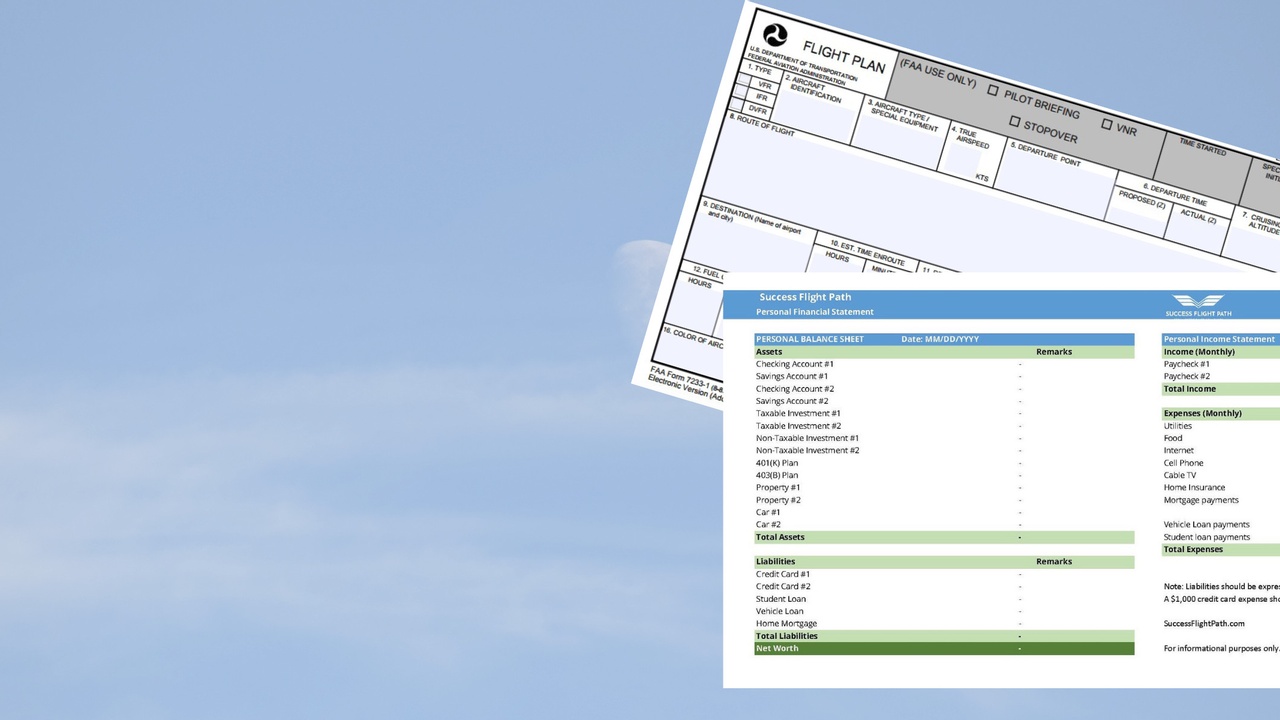
Whew, did we hit financial wake turbulence last year!
Many pilots slammed into major wake turbulence in 2020 because they didn’t have a financial flight plan!
As pilots, we train for the "unexpected" so that when something goes wrong in our aircraft, we are ready and prepared. Flight instructors have hours of instruction on how to get out of wake turbulence, but no one teaches us how to recover from hitting financial wake turbulence.
In fact, in most cases, professional pilots get little to no financial education before taking the controls of their aircraft.
It’s imperative that we prepare for the unexpected in the cockpit and in our bank accounts, especially when it comes to financial wealth building. Last year’s downturn was caused by factors well beyond our control....like furloughs and layoffs.
But the devastation in the airline industry and our national economy jolted most households, while others took it all in stride.
What was the difference? Whether or n...
Expect the unexpected

If 2020 has taught us anything, it’s always be ready for the unexpected.
As a Floridian, I am always ready for Hurricane Season. My family stocks up on essentials, especially bottled water and we make sure our trees are trimmed before the season starts.
As pilots, we train for the "unexpected" so that when something goes wrong in our aircraft, we are ready and prepared.
It's imperative that we are prepared for the unexpected in other areas of our lives - for the downturn that may be caused by factors well beyond our control.
In 2020, many Americans stayed home and curbed spending as they remained uncertain about their financial futures, about their jobs. In fact, many pilots lost their careers when airlines shut down all together.

This year, however, is proving to paint a different picture and more and more people are vaccinated and feel more comfortable about getting out and more comfortable spending money.
Companies like Target and the parent company of Outbac...
Stressed about money? You're not alone.

Is the state of your finances stressing you out?
You're not alone.
A recent survey showed that finances are the #1 cause of stress.
Politics, work and family issues followed suit.
But there are a few strategies you can use to minimize financial stress. Here they are:
✈ Get clear on your financial situation - How much do you make? How much do you owe?
✈ Get Financial Goals - think about how money stresses you - Are you in debt? Are you living paycheck to paycheck?
✈ Set priorities about paying off debt - How much is the debt, plus the interest on that debt costing you financially and emotionally?

✈ Create a budget - or a guideline for your money! Make it easy on yourself but don't forget to set aside a bit of money to enjoy.
✈ Check your accounts on a regular basis. This allows you to see if your cash flow doesn't align with you goals, or if there has been fraudulent activity.
✈ Don't be hard on yourself. Every once in a while you are going to spend more than you wanted. Just realize that a p...
Just get going...

Drop the Debt Burden


- Set an achievable goal
- Make a budget, including debt repayment
- Use an app – make it easy
- Improve your credit score
- Try avalanche method of debt repayment
- Try the snowball method of debt repayment
- Adjust savings goals
- Adjust, or establish investment contributions
- Consider balance transfers to credit cards with lower interest rates
- Negotiate credit card rates
- Check your credit report
- Talk to a debt counselor, if applicable
- Ask for debt reduction
There is "good" debt - such as mortgage debt the produces income, but most Americans carry consumer debt that not on
...Get off the roller coaster - and still live the dream!

In an ideal world of aviation, pilots would start with a legacy carrier before they turn 30, start saving for retirement by at least maximizing their 401(k) account and stay married to the same spouse for the entire time.
The previous scenario should create a very nice income to support a very nice retirement lifestyle.
Unfortunately for many, "livin' the dream" doesn't look like that. It sometimes looks like you're hanging on for dear life!

Instead it's a roller coaster, with income taking massive swings as pilots progress from one airline to another, sometimes taking a furlough or displacement along the way. And those are the lucky ones!
Many pilots have seen their jobs collapse right under their promising career as the carriers close shop.
Personally, I have experienced two airline closures, two furloughs and a displacement.
Just when I though the going was going well, 9/11 happened. And then you realize it's well beyond your control.
Never again.
N...
Do you have a plan or destination or are you just running amok?
As pilots we usually have a destination, well before planning for the actual trip begins.
It's essential. How else will you know what variables go into the flight planning?
What's your payload? How's the weather? What's the best routing? How much fuel will you need? What are your alternates, just in case things don't go as planned?
You can visualize the differences in flight plans between a flight from New York to Paris, compared to a flight from New York to Florida.
The timing and effort spent before for the longer flight reflects more extensive planning.
Your money works the same way.
Planning for a life of luxury will differ from planning for an “average” lifestyle. If you don’t aim for Paris, you’ll never get there. If you don’t aim for a comfortable retirement, you won’t get there!

Unfortunately, most people don't plan for the endgame. They're barely making ends meet, or they're saving a little, but have no plan for the endgame.
It's essential to know what you want bef...