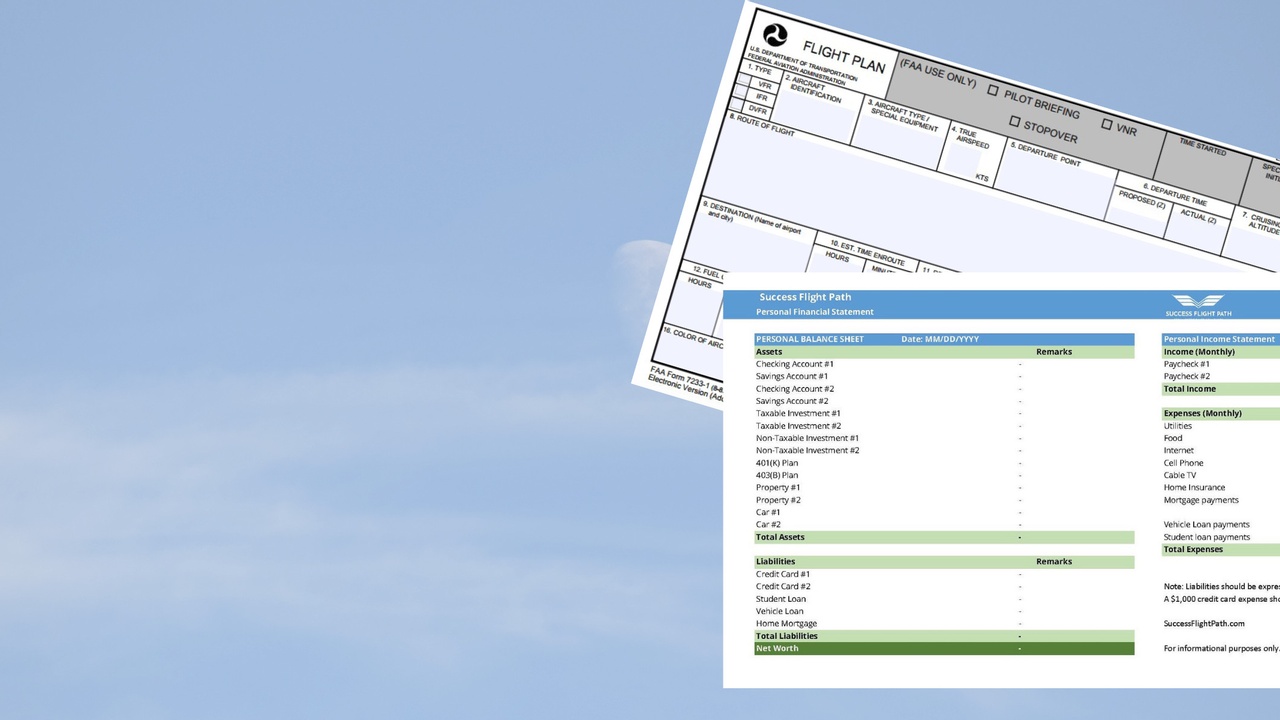
Navigating Financial Skies with Budgeting

As commercial airline pilots, managing personal finances effectively is essential amidst the dynamic nature of our careers.

To navigate the financial skies with confidence, it's crucial to employ the right budgeting strategies. Here are five tailored budgeting approaches to help pilots take control of their finances and soar towards their financial goals.

  1. Traditional Budgeting:
  • Track income and expenses meticulously, either manually or using user-friendly budgeting apps.
  • Categorize expenses to gain insights into spending patterns, such as housing, travel, and aviation-related costs.
  • Identify areas for optimization to ensure financial stability amidst fluctuating income and expenses.
  1. 50/30/20 Rule:
  • Allocate 50% of income to essential needs like housing, utilities, and aviation-related expenses.
  • Dedicate 30% to discretionary spending, including travel adventures, hobbies, and relaxation.
  • Commit 20% to savings and investments, ensuring a solid financial foundation f
  • ...
Continue Reading...

Build a Stable Future: Diversify Your Income as a Commercial Airline Pilot

We all like to take control!

That’s the feeling we get when we take hold of the yoke, or side stick, whether it’s a small single-engine plane, or a transport category aircraft and guiding it skyward, or manipulating the controls for a greased landing!

While we are in control of our flight path, many of us haven’t had the education or the checklist to take control of our financial flight path.

Even on a good day our income depends on so many factors out of our control: the weather; mechanical issues, ground stops, union negotiations, company policies and FARs (that’s Federal Aviation Regulations, for the non-aviation geeks reading!)

Then there is the once, or twice a year medical exam and scores of periodic training sessions, computer-based training and practice in the full-flight simulator.

Few other professions face our unique situation that often spans multiple time zones.

Few other professions face periodic layoffs and displacements – which either eliminate or decimate your ...

Continue Reading...

Secure your financial flight path with diversified income

 Last week I was flying with a new hire First Officer and had a senior wide-body captain on the jumpseat.

 After all the nice pleasantries and taking off, our conversation turned to the last year's turmoil - the cost Covid-19 had on the airline industry.

The new First Officer thought he had made it - landed a pilot job with a Legacy Carrier.

 Both myself and the Senior Captain couldn't stress enough the importance of having a secondary source of income - just in case.

 In the airline industry, it's never "just in case." It's not a matter of if, but a matter of when - when the industry takes a nose dive again.

 It seems that aviation is hit with some sort of unpredictable and uncontrollable Category 5 financial hurricane ever eight to 10 years.

 9/11

 The 2008 recession

 Covid-19 lock-downs

 Several airlines didn't survive this round.

 Hundreds of pilots received the dreaded news:

“Due to current unforeseen business circumstances beyond our control, the Company has made the ...

Continue Reading...

Flight Planning your Finances

When flight planning, do you begin with the departure point, or your destination?


How about planning for retirement, even if it's a few decades away?


Did you start when planning for retirement when you started flying, or will you begin right before you turn 65, when you're grounded by federal law?


Airline pilot unions do an amazing job with retirement seminars. But other than signing up for the company 401k or other retirement programs, there is little to no education on what to do with your money.


Do you roll the dice with a pre-selected investment strategy? Do you manage the account your self or get help?


One area to start is to work the numbers backwards. Where do you want to be at the end of your flying career? Start a Point B. You already know where your starting point.


Do you want to retire with $3,000 a month income?


$10,000 a month?


$20,000 a month?


Is it all going to come from your 401k, or defined benefits plan? Or will a portion of that co...

Continue Reading...

Hitting financial wake turbulence

Whew, did we hit financial wake turbulence last year!


Many pilots slammed into major wake turbulence in 2020 because they didn’t have a financial flight plan!


As pilots, we train for the "unexpected" so that when something goes wrong in our aircraft, we are ready and prepared. Flight instructors have hours of instruction on how to get out of wake turbulence, but no one teaches us how to recover from hitting financial wake turbulence.


In fact, in most cases, professional pilots get little to no financial education before taking the controls of their aircraft.


It’s imperative that we prepare for the unexpected in the cockpit and in our bank accounts, especially when it comes to financial wealth building. Last year’s downturn was caused by factors well beyond our control....like furloughs and layoffs.


But the devastation in the airline industry and our national economy jolted most households, while others took it all in stride.


What was the difference? Whether or n...

Continue Reading...

Drop the Debt Burden

Did 2020’s Pandemic leave you worse off, or better off financially?
 
Did you incur more debt, or whittle it down?
 
Debt is one of the biggest hurdles to creating wealth.
 
 
A recent survey shows that American’s biggest financial goal is getting rid of debt.
 
Like anything worth doing, create a plan and think long-term.
 
How are you planning on tackling debt in 2021?
 
Here are a few ideas:
 
  • Set an achievable goal
  • Make a budget, including debt repayment
  • Use an app – make it easy
  • Improve your credit score
  • Try avalanche method of debt repayment
  • Try the snowball method of debt repayment
  • Adjust savings goals
  • Adjust, or establish investment contributions
  • Consider balance transfers to credit cards with lower interest rates
  • Negotiate credit card rates
  • Check your credit report
  • Talk to a debt counselor, if applicable
  • Ask for debt reduction

There is "good" debt - such as mortgage debt the produces income, but most Americans carry consumer debt that not on

...
Continue Reading...
Close

50% Complete

Join the Journey

Take control of your own Success Flight Path, survive and thrive during turbulent times.