Growth vs. Value Investing — and Why Pilots Should Understand Both (Plus What Lives Off Wall Street)
Jan 19, 2026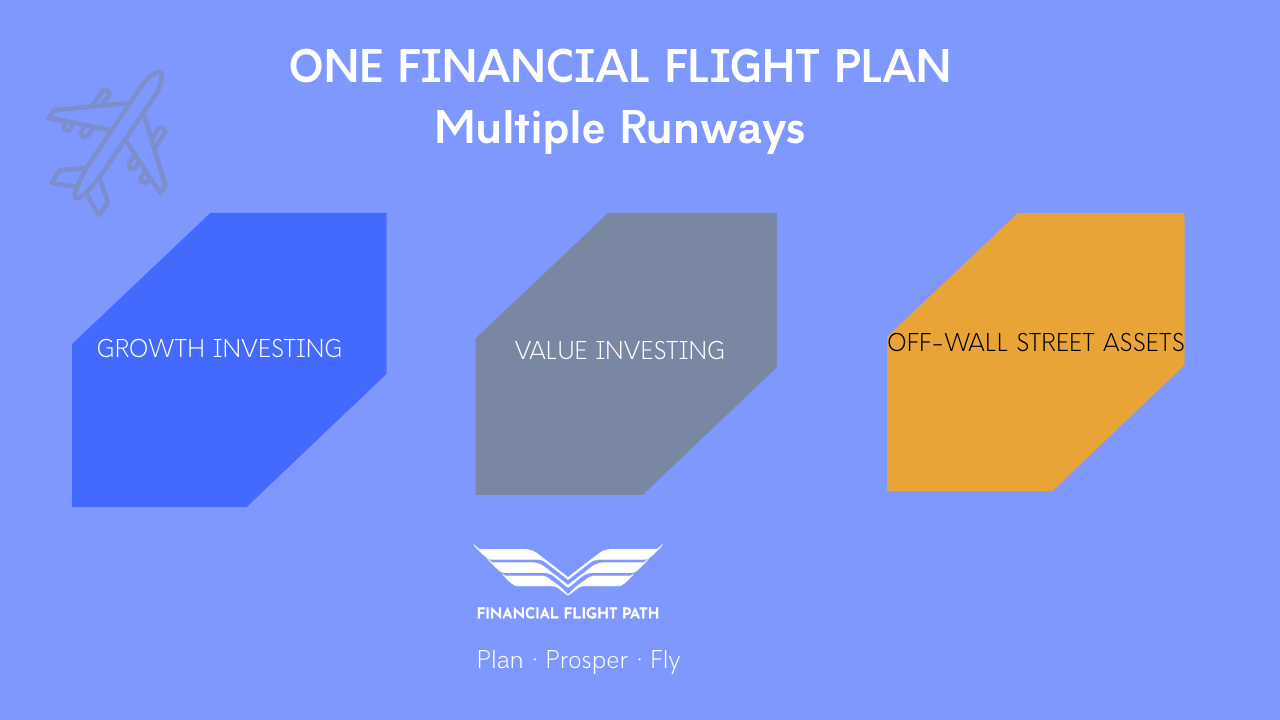
One of the first questions pilots ask when they start investing outside the cockpit is deceptively simple:
“Should I focus on growth or value?”
Like most things in aviation and investing, the real answer is: it depends on your mission, your risk tolerance, and your time horizon.
Growth and value investing are two classic approaches used in the stock market, and understanding the difference helps you make smarter decisions—not just with stocks, but with every investment you evaluate, including real estate and off-Wall Street opportunities.
Let’s break it down in plain English.
Growth Investing: Betting on What Could Be
Growth investing is about companies that are expected to grow faster than the overall market. These are businesses reinvesting profits to expand operations, develop new products, or capture market share rather than paying dividends.
Think of growth investing as flying toward where demand is going, not where it’s been.
Characteristics of Growth Investments
-
Profits are typically reinvested, not paid out as income
-
Often newer or innovative companies
-
Prices can look “expensive” based on traditional metrics
-
Valuations assume strong future performance
Because investors are paying for future potential, growth stocks often trade at higher price-to-earnings or price-to-sales ratios.
Returns & Risk
-
Growth investments tend to outperform when markets are rising
-
They can underperform sharply during market downturns
-
Volatility is part of the deal
Growth investing usually requires:
-
A longer time horizon
-
A higher tolerance for drawdowns
-
The emotional discipline to stay invested when markets get turbulent
For pilots early in their investing journey or with strong airline income, growth assets can make sense—but only if you understand the risk.
Value Investing: Buying What the Market Overlooked
Value investing focuses on companies trading below what investors believe they’re truly worth.
These are often established businesses that may be temporarily out of favor due to:
-
A disappointing earnings report
-
Broader market fear
-
Industry-specific challenges
Value investors look for fundamentals that suggest the company is stronger than its current price reflects.
Characteristics of Value Investments
-
Lower valuations compared to peers
-
Often established, cash-flowing businesses
-
May pay dividends or return capital to shareholders
-
Less “exciting,” more predictable
Returns & Risk
-
Value investments often shine during market recoveries
-
They tend to be less volatile than growth stocks
-
Returns may come from both income and appreciation
The risk? Sometimes the market is right. A stock can stay undervalued—or decline further—if the business never recovers.
Value investing often appeals to pilots who:
-
Prefer steadier income
-
Are closer to retirement
-
Want to reduce volatility in their portfolio
Growth vs. Value Isn’t Either/Or
Most experienced investors—and most airline pilots who’ve been through a few industry cycles—don’t choose one exclusively.
They blend.
Just like you wouldn’t fly with a single backup system, relying on only growth or value creates unnecessary risk. A diversified approach helps smooth returns across different market conditions.
But here’s where Financial Flight Path takes things a step further.
What About Off-Wall Street Investing?
Wall Street is only one runway.
Many pilots are surprised to learn that some of the most compelling opportunities aren’t found in public stock markets at all.
Off-Wall Street investing includes assets that are not publicly traded and often provide:
-
Cash flow
-
Inflation protection
-
Lower correlation to the stock market
Common Off-Wall Street Investment Categories
1. Real Estate
-
Residential rentals
-
Small multifamily
-
Commercial properties
-
Syndications and private funds
Real estate can function as both growth and value, depending on the strategy:
-
Growth: development, appreciation-focused markets
-
Value: income-producing properties with strong cash flow
2. Private Businesses
-
Small business ownership
-
Franchise investing
-
Private equity deals
These often reward operational improvement and long-term ownership rather than short-term price movement.
3. Private Credit & Income Funds
-
Debt funds
-
Real estate lending
-
Income-focused private placements
These appeal to investors seeking predictable income rather than appreciation.
4. Alternative Assets
-
Farmland
-
Energy projects
-
Specialty assets with defined cash flows
- Private lending
Why Pilots Are Uniquely Positioned
Pilots have some advantages many investors don’t:
-
High income (but often cyclical)
-
Strong discipline and checklist thinking
-
A deep understanding of risk management
That makes pilots especially well-suited to building diversified portfolios that combine:
-
Growth assets for long-term appreciation
-
Value and income assets for stability
-
Off-Wall Street investments to reduce reliance on public markets
This isn’t about chasing returns—it’s about building resilience.
The Financial Flight Path Approach
At Financial Flight Path, the goal isn’t to tell you what to invest in.
It’s to help you:
-
Understand how different investments work
-
Evaluate risk intelligently
-
Build multiple income streams over time
Whether you’re investing in:
-
Growth stocks
-
Value funds
-
Rental real estate
-
Private deals
…the same principles apply:
-
Know the fundamentals
-
Understand the downside
-
Align the investment with your long-term plan
Final Thought
Markets will change.
Airlines will cycle.
Technology will disrupt.
Your job as an investor isn’t to predict the future—it’s to prepare for it.
Growth, value, and off-Wall Street investments all have a place when used intentionally. The key is building a portfolio that can fly smoothly through turbulence, not one that only works in clear skies.
That’s the heart of Financial Flight Path.
Plan smart.
Build resilience.
And never rely on a single engine.
Stay connected with news and updates!
Join our mailing list to receive the latest news and updates from our team.
Don't worry, your information will not be shared.
We hate SPAM. We will never sell your information, for any reason.