Rich Pilot, Poor Pilot
Oct 30, 2026
Rich Pilot, Poor Pilot
Why your seniority number isn't a financial plan
· @Melinda Zisser
Same seat, same paycheck
Picture two captains at the same airline. Same aircraft, same seniority, same pay, same commute.
On paper, they're identical. Twenty years from now, they won't be.
One of them will retire with options, flexibility and income that doesn't depend on any single company. The other will retire hoping the plan held.
The difference won't come from how well either of them flew. It will come from a decision most pilots never realize they're making: whether their airline paycheck is their only source of income, or just the first one.
The four quadrants
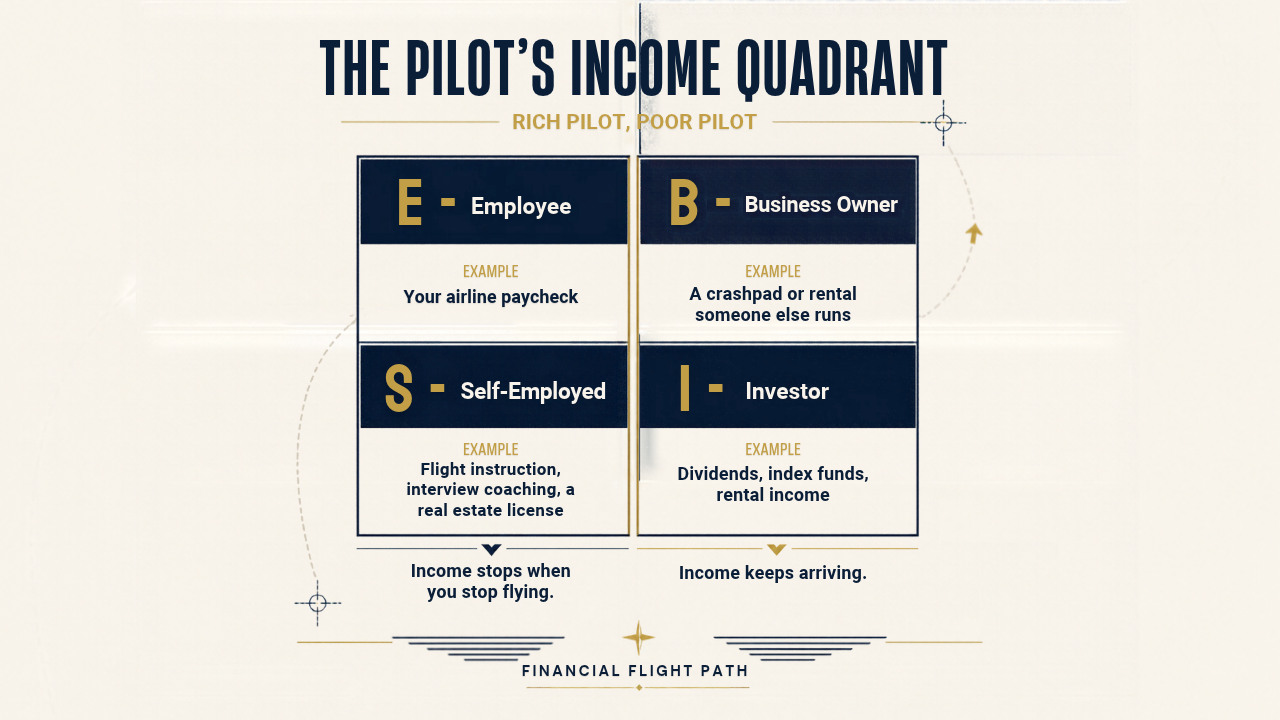
In Rich Dad's Cashflow Quadrant, author Robert Kiyosaki sorts the ways people earn money into four groups:
- E (Employee): You trade your time and skill for a paycheck from someone else's company.
- S (Self-employed): You own your job. You earn when you work, and the business usually depends on you personally.
- B (Business owner): You own a system that earns money whether or not you're there to run it.
- I (Investor): Your money works for you, through stocks, real estate or other assets.
The left side (E and S) is income you earn by showing up - like when you're flying! The right side (B and I) is income that keeps arriving when you don't - like when your on a Caribbean beach.
Notice that the quadrants describe where your money comes from, not what you do for a living. A captain drawing an airline paycheck earns as an E. That same captain coaching new hires through interview prep on days off is earning as an S.
If the captain also owns a crashpad someone else manages, or a portfolio that pays dividends, money is arriving from B and I too. Many people live in more than one quadrant without ever noticing.
That's the core idea behind the framework: the source of your income matters more than the size of it.
Pilots are the ultimate E quadrant
Few professions live more fully in the E quadrant than airline pilots. Our pay, our schedule, our base, our benefits and even our retirement date are set by an employer, a contract and a seniority list.
And here's the part some money gurus get wrong: that is not a bad place to be.
A senior captain's income is excellent. The retirement contributions can be generous. You don't have to make payroll, chase customers or work weekends to keep the lights on.
The E quadrant isn't the problem. The problem is when it's the only quadrant.
A single point of failure
We would never fly an airplane with one engine, one hydraulic system and no backup. Yet many of us run our finances exactly that way.
I learned this the hard way. Before I ever got to Continental, I watched two airlines I flew for shut down. Then I was a brand-new Continental pilot in Newark on September 11, 2001. Within weeks, I was choosing between a furlough, flowing back to the Express side, or a leave of absence. I took the leave.
None of that had anything to do with how well I flew. My income was tied to one company, and when that company hit turbulence, so did I.
Over the next 25 years, I built redundancy. I kept flying, and I retired this October as a 737 Captain and Line Check Airman at United.
But along the way I also ran a crashpad for crews in Newark, earned my real estate license, started a property management company and built an investment holding company.
Without planning it this way, I ended up with a foot in all four quadrants.
Rich Pilot, Poor Pilot: three scenarios
Go back to our two captains. Captain A lives entirely in the E quadrant. Captain B flies the same line but has quietly built a second and third income stream: a rental property, an index fund portfolio outside the company plan, and a small side business.
Now put them both through three things every pilot career can throw at you.
|
What happens |
Captain A (E only) |
Captain B (E plus more) |
|---|---|---|
|
Furlough, merger or bankruptcy |
Income drops to zero or near it overnight. Savings start draining. |
Paycheck drops, but rent, dividends and side income keep arriving. |
|
Loss of medical certificate |
The career, and the income, can end with one exam. |
The flying income stops. The other streams don't need a medical. |
|
Mandatory retirement at 65 |
Income falls off a cliff on a date set by law. |
The paycheck ends, but the other quadrants keep running. |
Captain A isn't careless. Captain A just trusted one system to do everything. Captain B treated income like an airplane: built with backups, because something eventually fails.
It's not what you make, it's what you keep
The quadrants don't just behave differently in a crisis. They're taxed differently too.
Your airline paycheck is earned income. In 2026 it's taxed at ordinary federal rates of up to 37%, with Social Security and Medicare taken out on top. Profit from an investment held longer than a year is usually taxed as a long-term capital gain, at 0%, 15% or 20%, plus an extra 3.8% at higher incomes.
That doesn't mean every pilot should start chasing tax strategies. It means a raise on the left side is worth less than it looks, and a dollar earned on the right side often goes further. A good CPA can tell you what that means for your own numbers.
Where I part ways with Kiyosaki
Kiyosaki's framework is useful, but I don't buy all of it. Rich Dad says the quadrant isn't telling anyone to quit their job tomorrow, but the overall push is still to leave the left side behind, and he is comfortable with a level of debt and risk that would make most check airmen wince.
To their credit, Rich Dad's own materials admit the right side carries real risk. Bureau of Labor Statistics data they cite shows only about half of new businesses are still operating five years after opening, and roughly a third after ten.
For pilots, I think that's the wrong lesson. You don't need to quit flying to build wealth. You need to stop letting one employer be your only engine.
The goal isn't escape. The goal is redundancy.
How to add a quadrant without leaving the flight deck
Pilots have something most employees don't: time off in large blocks, a flexible bid schedule and a network of people in every city. That makes adding a quadrant more realistic than you might think.
- S (Self-employed): Flight instruction, type-rating or interview coaching, aviation consulting, or a professional license like real estate that fits around a schedule.
- B (Business owner): A crashpad, a short-term rental or a small service business that someone else can run day to day.
- I (Investor): Consistent investing outside your company plan, or a rental property bought with clear numbers and a reserve fund.
You don't need all three. One additional engine changes everything about how a furlough, a medical or your 65th birthday lands.
Before you jump in, run it through the same discipline you use in the cockpit:
- Pause and Assess: Where does every dollar of your income come from today?
- Orient: Which quadrant fits your time, skills and risk tolerance?
- Weigh Options: What does it cost, what can go wrong, and what's the realistic return?
- Execute: Start small and keep it simple.
- Review: Check it every year, just like a recurrent checkride.
Which captain are you?
Your seniority number tells you where you'll sit on the airplane. It doesn't tell you where you'll land financially.
So here's my question for you this week: if your airline paycheck stopped tomorrow, what income would still show up next month? If the answer is "nothing," you don't need to panic. You just need to start building your first backup engine.
Stay connected with news and updates!
Join our mailing list to receive the latest news and updates from our team.
Don't worry, your information will not be shared.
We hate SPAM. We will never sell your information, for any reason.